Compassionate release takes a major hit, a death-row prisoner wins an important victory, Just Justice expands to YouTube, and take action on Delaney Immigration Detention Center.
Dear Friends,
June brings fresh strawberries and summer solstice, my favorite day of the year. It also gives us a time to process the Supreme Court end-of-term rulings, including some significant second look cases. Read on for a short primer on what the Court decided last week, details about Just Justice’s exciting new audio launch on YouTube, a special birthday shout-out, and ways to take action on Delaney Hall in Newark, New Jersey.
Bad News on Compassionate Release: What the Supreme Court Just Did (and Why It Matters)
Last week, the Supreme Court made it significantly harder for people in federal prison to get a second look at long sentences.
The first case, Fernandez v. United States, involved a federal prisoner serving a life sentence. Fernandez claimed he was actually innocent and sought release under the federal compassionate release statute. A federal judge, agreeing there were real questions about his innocence, granted Fernandez’s motion. The Supreme Court reversed, holding that compassionate release cannot be used as a vehicle for innocence claims — or other challenges to the validity of a conviction.
The second case, Rutherford v. United States (decided alongside Carter v. United States), involved people serving lengthy prison sentences under laws that had been changed by Congress because they were overly harsh. Indeed, if sentenced today, the two men would very likely have received much shorter sentences. Rutherford and Carter argued that this enormous sentencing disparity between the older, harsher version of the law (which resulted in their long punishment) and the revised version of the law was an “extraordinary and compelling” reason for compassionate release.

The Supreme Court disagreed, holding that judges generally cannot use compassionate release statutes to reduce a sentence simply because the law has changed and the person would be sentenced differently today.
The practical result is striking, leaving people in prison for crimes, which if committed today, would result in much less severe punishment. The year of the crime — not their criminal acts — determines their sentence. And although the Sentencing Comission appeared to allow judges to consider that disparity for compassionate release purposes, the Supreme Court has ruled otherwise.
Taken together, Fernandez and Rutherford mean that the path to a second chance through compassionate release just got a whole lot narrower. Federal judges have less room to revisit questionable convictions and overly harsh sentences imposed under laws that Congress itself has since concluded were too severe.
The fight now shifts to Congress and the Sentencing Commission. Next month, I’ll write about what options remain and where reform efforts may go from here.
Not All Gloom and Doom from the Court
In a bright spot amid the otherwise bad news, the Supreme Court, in Pitchford v. Cain, ruled 5–4 in favor of Terry Pitchford, a Black man on Mississippi’s death row. At trial, the prosecutor had removed four of the five eligible Black jurors from serving in the case. When Pitchford’s lawyers tried to argue that the prosecutor’s actions were motivated by racial discrimination, the trial court shut the discussion down. The Supreme Court said that was error and sent the case back for further consideration.
At a time when the Court is scaling back other avenues for relief, Pitchford serves as a reminder that the Court is still willing, at least in some cases, to enforce constitutional protections against racial bias in the justice system.
Just Justice in Now on YouTube
Just Justice has always been about second chances. Now the episodes are getting a second chance too. We have launched an audio YouTube channel, where you can revisit the conversations that stayed with you, and find new ones that you may have missed along the way.

We’ve also had a terrific start to Season 4, including powerful conversations with:
- Damon “Sharuka” Venable (featured in last month’s newsletter);
- Iris Eytan, founder of Protect Ethical Prosecutors, on to talk about prosecutor misconduct and what real accountability looks like;
- and Mujahideen Muhammad, founder of Pillars of Promise, coming soon!
If a particular episode over the last four seasons has moved or inspired you, I’d love to hear from you. Share your thoughts, and I may feature them on our website or social media to help introduce more people to these important conversations.
A final ask…. could you please leave a rating or short review on Apple Podcasts? It genuinely helps new listeners find the show. It takes less than a minute and makes a real difference for a small, independent podcast like Just Justice. Thank you!
Happy Birthday and “Happy to Chat” Benches
Happy birthday to the amazing Ken Waitz. I know nothing would make him happier than to have you check out his organization, HappytoChatBench.org, which promotes social connection, one bench at a time.
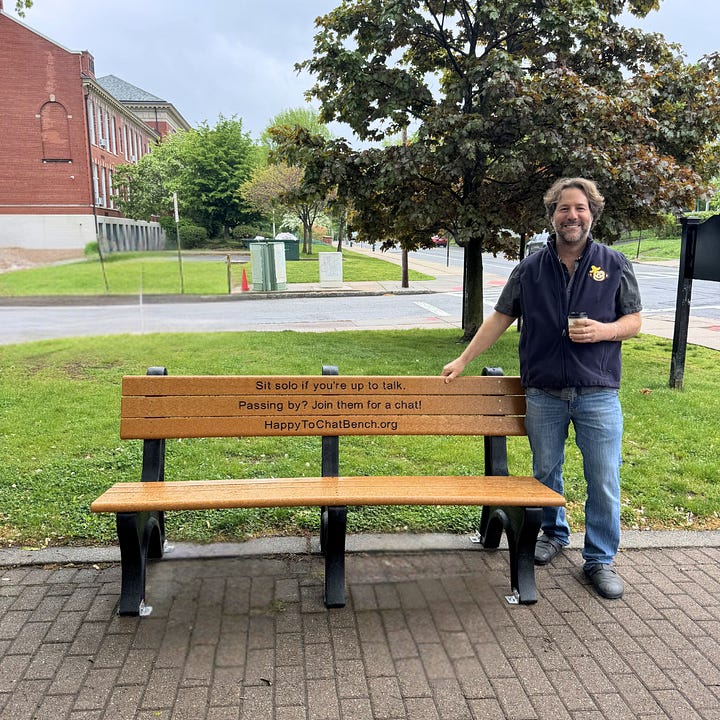
Happy To Chat has installed free benches across the country, including in New Jersey, Tennessee, Virgina, and Florida, with more in production. Do you know a place that needs a free “happy to chat” bench to increase community connections? Reach out to Happy to Chat through the website.
Delaney Hall and Action Steps
A final note for readers concerned about what’s happening at the Delaney Immigration Detention Center in Newark, N.J. You don’t need to protest in person to show your concern. You can reach out to your congresspeople, and tell them that you don’t want your tax dollars funding these kinds of detention centers. You can support legal watchdog organizations like the NJ-ACLU, or donate to the people being held at Delaney and their families through the following accounts:
- https://givebutter.com/commissaryfund
- https://givebutter.com/DHEmergencyFunds
- https://givebutter.com/DHFreeThemAll
You can even reconsider your banking choices, as one NJ filmmaker did when she learned her bank, Citizens Group, was one of the largest supporters of CoreCivic and GeoGroup, who finance ICE detention centers — including Delaney Hall.
If you know of other ways to show support, please leave them in the comments. We are stronger when we stand together.
I am grateful for you and for all that you do.
Take good care,
Jessica